

01 · The Shift from Monolithic Debt to Tailored Infrastructure
When commercial enterprises experience recurring security alerts, unvetted extension conflicts, or server-level resource exhaustion on dynamic platforms, the conventional agency recommendation is to install another security plugin or upgrade the hosting tier. This merely papers over the symptom while compounding the underlying technical debt.
A resilient digital perimeter requires an architectural break. Modern infrastructure engineering does not rely on off-the-shelf, pre-packaged page builders; it deploys purpose-built, custom codebases using modern frameworks (React, Next.js, structured HTML5, modern CSS, and modular JavaScript).
By severing the public web interface from dynamic runtime interpreters and publicly reachable databases, custom-coded web architectures replace fragile execution environments with an immutable, deterministic perimeter.
02 · Phase 1: Upstream IP Isolation & The Neighborhood Enclosure Model
On conventional site builder setups, every incoming connection request from anywhere in the world reaches the application server directly. A custom-coded deployment flips this exposure model through edge-level IP and regional perimeter enclosures:
1. Regional Perimeter Enclosure (The Gated Neighborhood):
Commercial organizations routinely operate within defined regional territories (such as domestic or provincial corridors). Yet standard deployments process connection requests from global autonomous botnets, offshore server farms, and known malicious proxy networks.
With custom edge routing, we apply upstream firewall policies directly at the DNS boundary. International automated scanners, scrapers, and overseas crawling farms are dropped before TCP handshakes complete. They cannot even view or resolve the public web interface.
2. Administrative Gateway Isolation (The Secured Control Room):
Consider the real-world physical security of a private compound:
• Layer 1: An uninvited visitor from outside the designated district cannot pass through the neighborhood perimeter to see the house.
• Layer 2: Even for trusted visitors permitted onto the property, the internal security control room remains completely hidden behind physical access controls.
In custom-coded edge environments, administrative gateways and content manipulation portals are completely decoupled from public web routes. The internal gateway is restricted to verified, whitelisted IP ranges and secured by private cryptographic access keys. Offshore botnets searching for administrative authentication routes receive immediate null drops—the door simply does not exist on public routes.
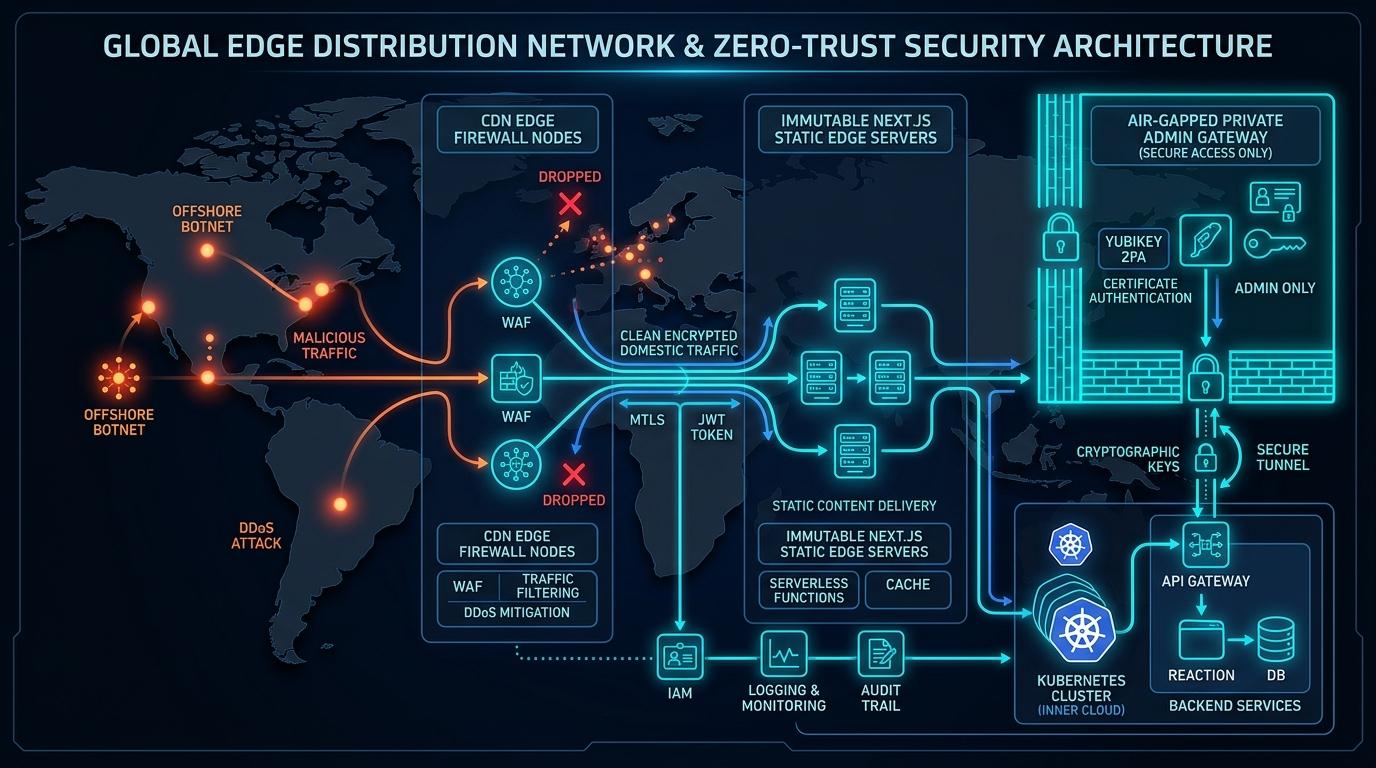
EVIDENTIARY CAPTURE:Global edge distribution topography illustrating upstream WAF regional filtering, immutable Next.js static edge delivery, and air-gapped administrative isolation.
03 · Phase 2: High-Fidelity Edge Telemetry & Forensic Anomaly Detection
Deploying custom-coded builds onto enterprise edge networks—such as Netlify or Vercel—fundamentally changes operational visibility.
Dynamic hosting dashboards provide little more than aggregated monthly hit counts or delayed access metrics. In contrast, modern edge distributions provide real-time, tamper-proof telemetry logs for every single inbound request:
1. Granular Request Telemetry:
Edge logging records the precise timestamp, the exact originating IP address, the autonomous system number (ASN), the physical routing location, the requested URI, and the user-agent string for every connection. You maintain continuous, unalterable documentation of precisely who accessed which asset, from where, and at what second.
2. Defeating Proxy & VPN Evasion:
Threat actors frequently route automated scripts through commercial VPNs or domestic proxy nodes to bypass rudimentary geographic blocks. Modern edge telemetry analyzes traffic behavior, TLS fingerprint anomalies, and header discrepancies in real time. If an IP claims to originate domestically but exhibits automated packet cadences, abnormal header structures, or rapid sequential asset requests, security operators immediately identify the anomaly and drop the route.
3. Proactive Triage vs. Blind Recovery:
Instead of discovering a compromise weeks after database records have been extracted, security teams monitor deterministic telemetry. Real anomalies stand out instantly against legitimate human traffic patterns, allowing immediate edge mitigation before any asset can be probed.
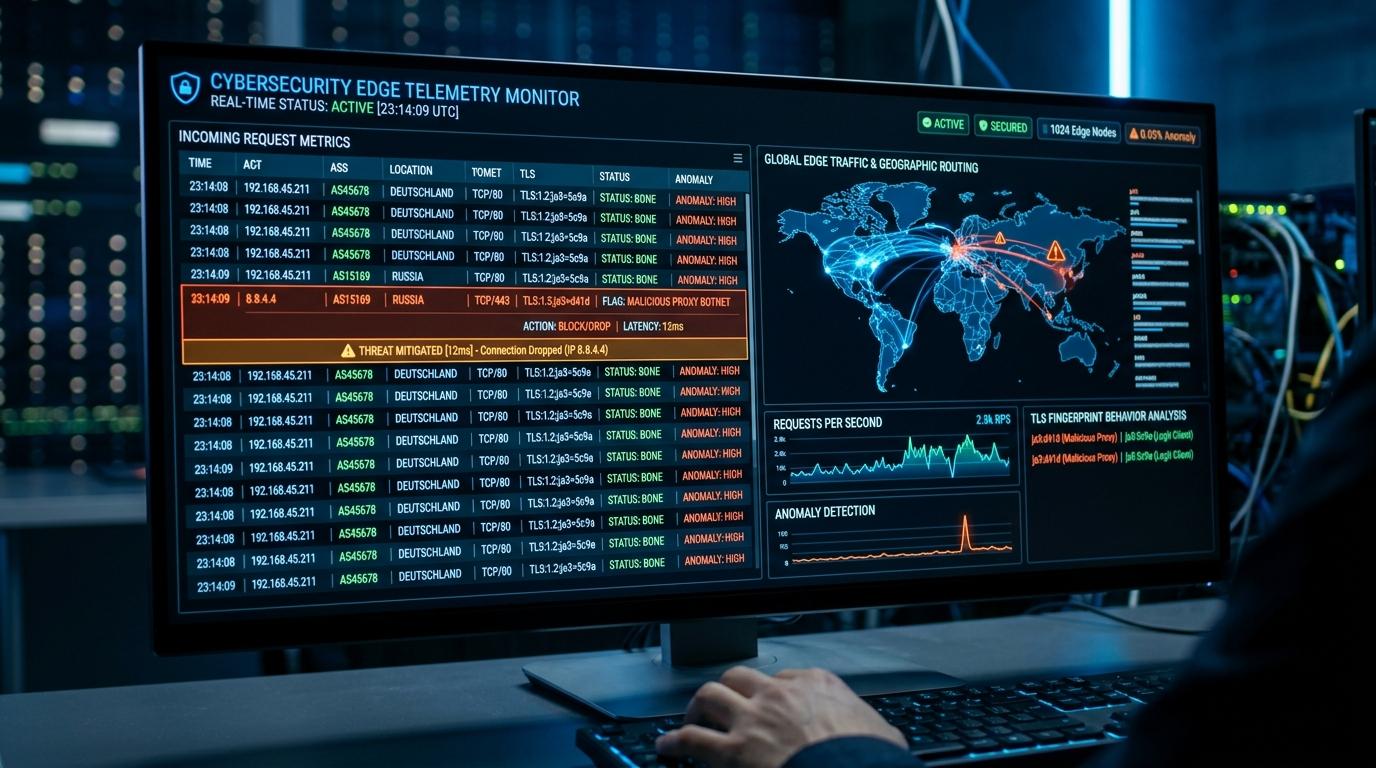
EVIDENTIARY CAPTURE:Enterprise edge telemetry monitor capturing sub-15ms request drops, autonomous system numbers (ASNs), TLS fingerprint discrepancies, and real-time geographic routing telemetry.
04 · Phase 3: Direct Feature Agility vs. The Agency Subcontractor Trap
Beyond defensive resilience, the transition to bespoke codebases permanently eliminates the compounding friction of platform templates and agency supply chains.
When a firm on a dynamic page builder wants to introduce a new operational capability—such as a custom booking workflow, an integrated client payment gateway, or a dedicated corporate publication hub—the traditional agency cycle triggers severe operational drag:
1. The Agency Outsourcing Carousel:
Most template agencies do not write native software. When you request a new booking module or payment system, their first step is searching a commercial marketplace for an off-the-shelf plugin. If no existing extension fits your operational workflow, the agency is forced to subcontract out to an unknown third-party freelancer to write an unvetted script patch.
2. The Compounding Time Tax:
Every intermediary layer doubles your project timeline. A feature that should take days stretches into months of scope confusion, plugin license negotiations, and compatibility testing across incompatible extensions.
3. The Disappearing Developer Dilemma:
When that custom plugin inevitably conflicts with a future host update or breaks a payment pipeline months or years later, the agency cannot repair it internally. They must track down the specific freelancer who wrote the bespoke code. In the vast majority of cases, that contractor is long gone, unreachable, or has left behind undocumented, tangled spaghetti code. The firm is left stranded with broken business functionality and zero recourse.
4. The Custom Code Advantage:
With an owned, modern codebase (Next.js/React), this entire administrative bottleneck vanishes. You are not renting closed templates or buying marketplace band-aids. If you require a new booking intake, a programmatic payment checkout, or an internal content section, your developers build the feature cleanly to your exact specifications without touching third-party marketplaces.
5. Border-Free Rapid Maintenance:
Because modern codebases adhere to standardized engineering architectures and strict version control (Git), any qualified engineer—whether sitting in your local office or collaborating from the other corner of the globe—can pull the repository, inspect the clean source code, deploy an enhancement, or resolve an anomaly within minutes. You retain 100% ownership, zero platform lock-in, and total operational control over your digital infrastructure.
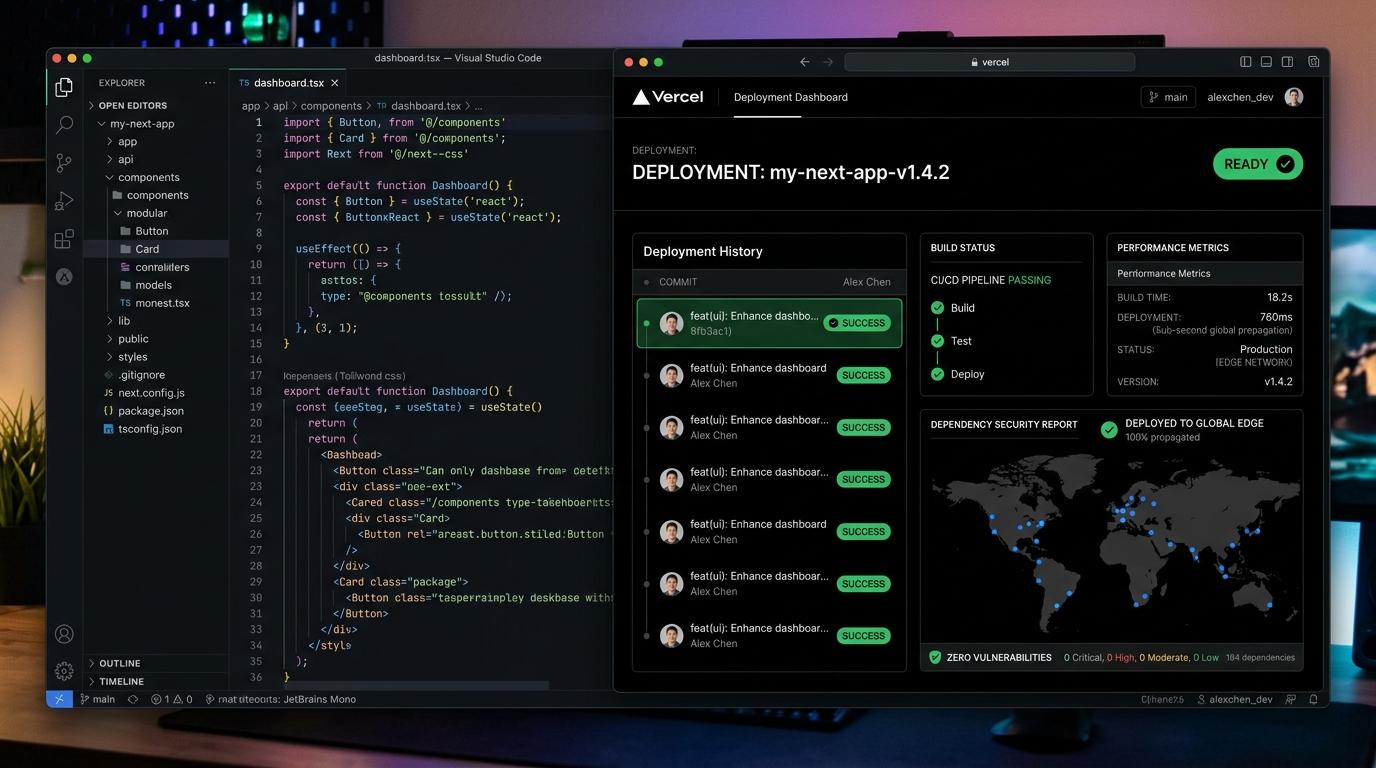
EVIDENTIARY CAPTURE:Modern Next.js source code architecture and CI/CD edge deployment pipeline delivering sub-second updates with zero external plugin vulnerability exposure.
05 · The Architectural Bottom Line & Code Sovereignty
Perimeter security and operational agility are not achieved by applying defensive patches to structurally broken runtime foundations. They are achieved by removing the attack surface and intermediary dependencies entirely.
Custom codebases deployed across isolated edge networks replace unpredictable dynamic interpreters with pre-compiled, lightning-fast static assets.
By combining regional IP fencing, air-gapped administrative gateways, and real-time edge telemetry with direct code sovereignty, organizations secure their digital perimeters permanently against automated botnet probes and vendor bottlenecks alike.