

01 · The Illusion of Managed Security & Live Execution Risks
A pervasive assumption among commercial operators is that deploying a site through visual builders and off-the-shelf web platforms—such as WordPress, Wix, or Squarespace—inherently offloads the operational burden of cybersecurity.
These platforms provide convenient drag-and-drop interfaces, ready-made layouts, and marketplaces filled with one-click extensions designed to expand functionality without custom programming.
From an infrastructure perspective, dynamic website architectures are not closed fortresses; they are live execution environments running dynamic application interpreters and active database listeners directly on the open web.
Every convenience feature introduces technical compromises. Organizations cannot buy absolute perimeter immunity from templated page engines, because the foundational architecture relies on third-party plugin supply chains, open runtime listening loops, and continuous dynamic execution.
02 · Phase 1: The Third-Party Plugin Supply Chain & Developer Reputation
No website built on an off-the-shelf web framework exists in isolation. To handle ordinary commercial features—such as intake forms, interactive portfolios, document repositories, and search indexing—the typical production deployment relies on anywhere from 15 to 40 individual third-party plugins and marketplace extensions.
Every single extension installed on the server introduces independent, unvetted code directly into the root execution environment:
1. The Unchecked Developer Dilemma:
Plugins are rarely engineered by verified security firms. They are authored by solo developers, third-party template agencies, or hobbyists worldwide. The integrity of an organization's digital perimeter becomes entirely dependent on whether an unknown developer in another timezone wrote clean, sanitized routines or cut corners to rush an update.
2. The Abandonment Trap (Dependency Rot):
A substantial portion of marketplace extensions go unmaintained or abandoned after a few years. As production hosting servers upgrade their underlying runtime environments (such as transitioning between major scripting language versions), unmaintained plugins decay silently. They do not display warning signs on the corporate homepage; they quietly introduce fatal flaws and bypass authentication checks without throwing visual errors.
3. The Compounding Risk Curve:
Exposure does not scale linearly with each extension; it compounds. Ten plugins do not represent ten vulnerabilities—they create hundreds of overlapping software hooks, unverified API endpoints, and execution collisions. One forgotten utility plugin is all an attacker needs to compromise the entire hosting filesystem.
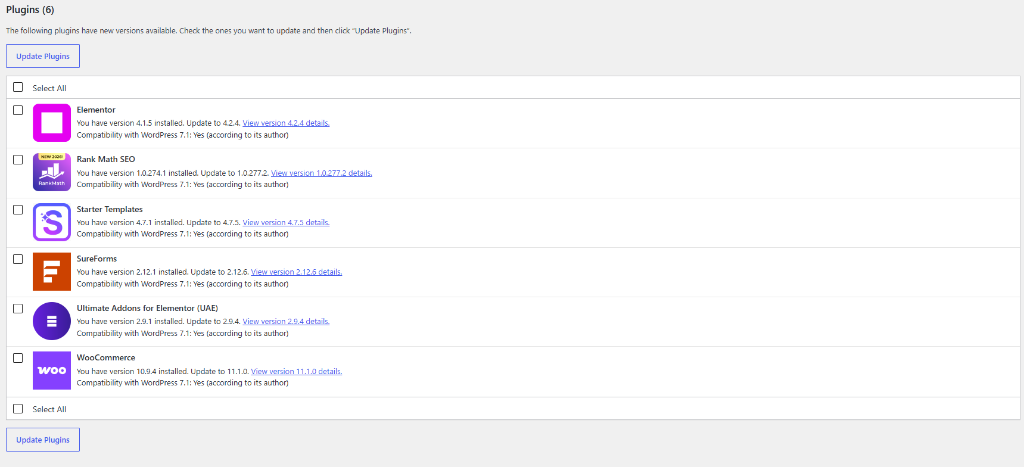
EVIDENTIARY CAPTURE:Live production environment exhibiting 6 critical plugin update backlogs across core visual builders, intake forms, and e-commerce routing engines.
03 · Phase 2: Runtime Execution Gaps & The SQL Injection Window
A major structural flaw of dynamic site platforms lies in how they assemble web pages during live traffic requests.
When a visitor requests a page on a dynamic site engine, the server must spin up a runtime interpreter, parse core platform logic, verify third-party extensions, and execute a query against an active relational database (such as MySQL).
Because the database listener runs concurrently alongside the web server, input parameters are vulnerable to automated tampering if they are not strictly escaped:
1. Unsanitized Functions & Sloppy Source Code:
Third-party extensions routinely rely on unsecured global functions (such as dynamic evaluation calls, unsanitized input arrays, or unescaped query builders) that fail to validate incoming input parameters. In many instances, developers inadvertently leave diagnostic routines active in production code—such as forgotten print/dump statements (print_r, var_dump) or debug flags that expose system paths, table prefixes, and server credentials directly within public HTTP responses.
2. The Injection Window:
If a form field or URL query parameter fails to sanitize input characters, an attacker injects structured database commands directly into the dynamic payload. Rather than loading a harmless page, the injected query returns the entire user authentication table, extracts private company records, or bypasses password validation to grant immediate administrative privileges.
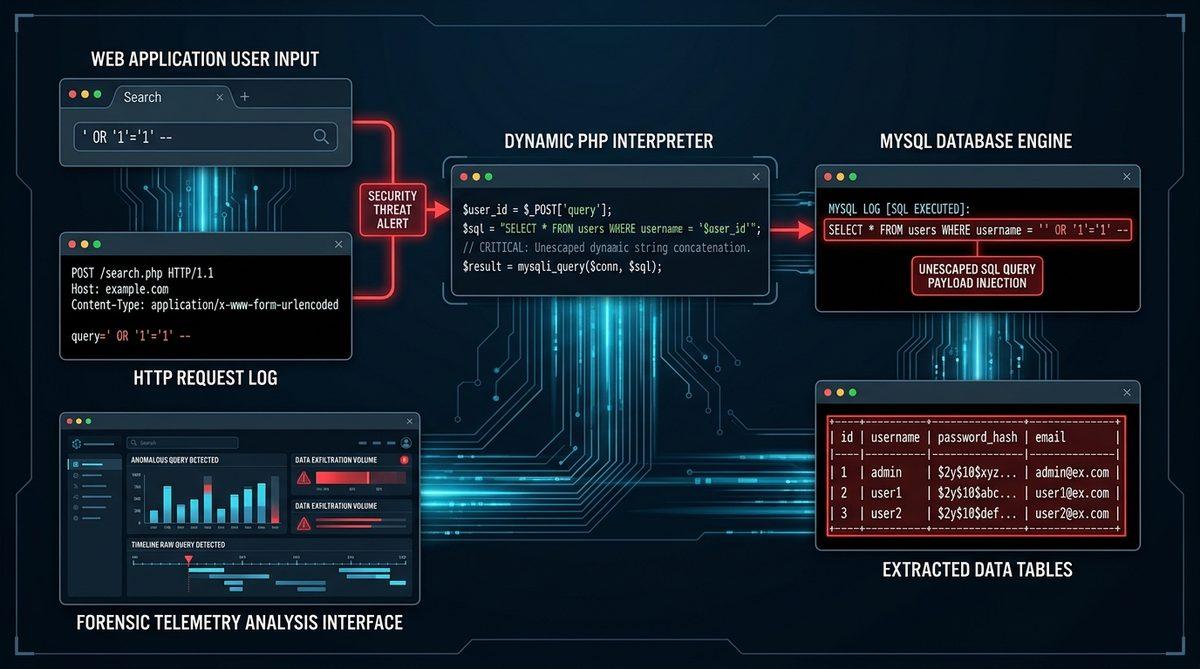
EVIDENTIARY CAPTURE:Forensic architectural breakdown of dynamic PHP interpreter execution flow, unescaped parameter injection, and relational database table extraction.
04 · Phase 3: Dynamic Forms as Denial-of-Service & Resource Exhaustion Vectors
Intake forms on dynamic platforms are frequently treated as simple contact utilities. In reality, every dynamic form is an unauthenticated gateway tied directly to the hosting server's CPU and database resources.
When automated exploit scripts or high-velocity crawlers target an intake form:
1. Concurrency Starvation:
Submitting a dynamic form forces the server to execute multiple background processes: validating fields, executing anti-spam filters, writing records into the database, and firing mail-transport daemons.
2. Resource Exhaustion (Denial-of-Service):
Automated botnets submit high-volume concurrent requests through unshielded forms. Because dynamic web engines cannot block distributed traffic floods at the network layer on their own, the server CPU hits 100% capacity. Database connection pools max out, resulting in persistent 504 Gateway Timeout or 500 Internal Server Error screens for actual clients and prospective partners.
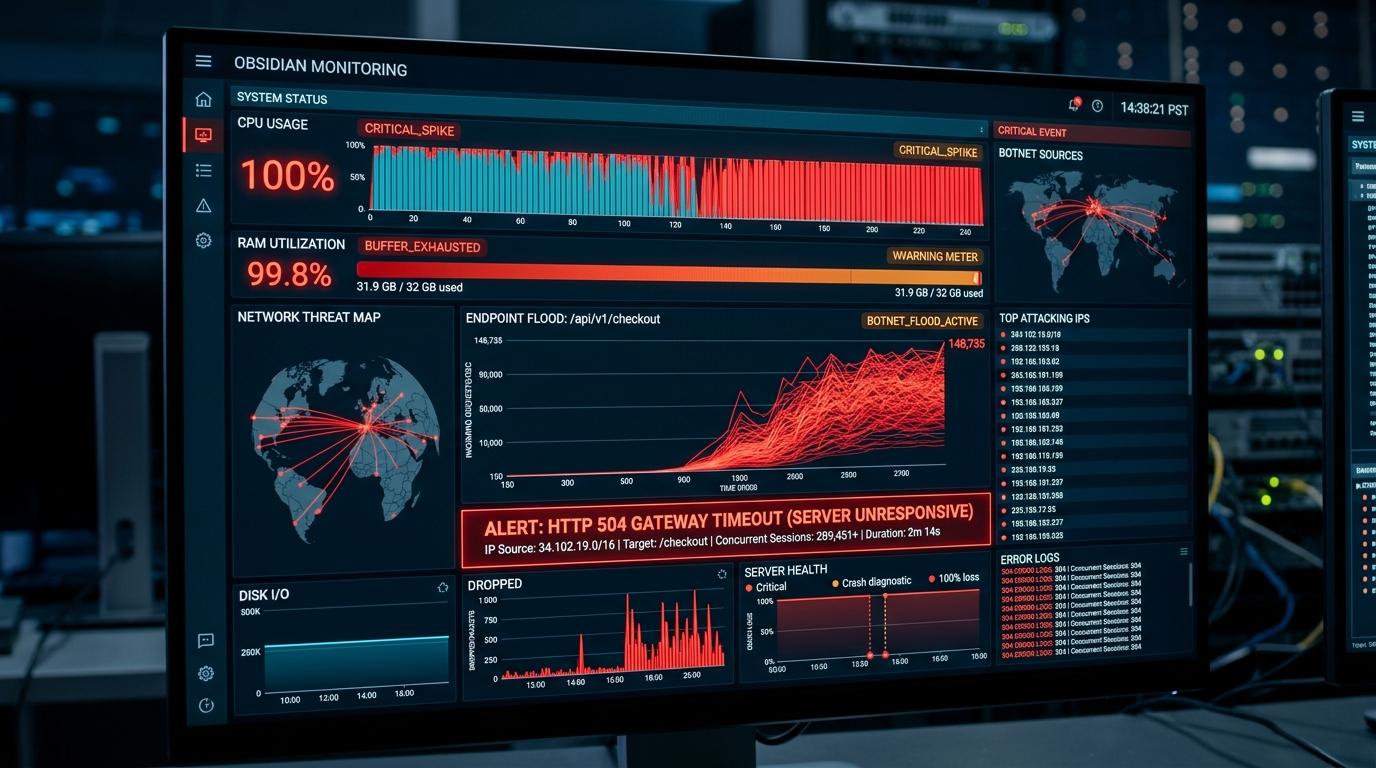
EVIDENTIARY CAPTURE:Server telemetry monitor displaying 100% CPU spike, RAM buffer exhaustion, and 504 Gateway Timeout failure caused by unshielded form endpoint flooding.
05 · Phase 4: Why Standard Platforms Cannot Block Distributed IP Probes
A common misconception among business owners is: "Can't we just block the attacker's IP address inside our site dashboard?"
An application engine cannot protect its own perimeter against distributed network probes:
1. Application-Level Latency:
By the time an internal security extension intercepts an incoming packet to evaluate whether an IP address should be blacklisted, the server has already spent system resources receiving the connection, launching the runtime environment, and parsing application files.
2. Botnet Evasion:
Modern attack infrastructure operates across distributed proxy networks, compromised residential IP pools, and cloud subnets worldwide. Blocking a handful of static IP addresses in a dashboard accomplishes nothing against autonomous scanners that rotate hundreds of non-domestic IPs every hour.
3. The Need for Edge-Level Isolation:
True IP filtering and regional geo-fencing can only occur upstream at the CDN/Edge layer, completely detached from the application filesystem. Relying on an internal plugin to block an attacker is like asking an intruder to stand in your foyer and inspect their own ID before deciding whether to enter.
06 · The Permanent Remediation Reality
The speed of modern automated vulnerability scanners has eliminated the safety buffer organizations once relied on. When a security vulnerability is publicly disclosed in a popular visual builder template or marketplace extension, automated botnets begin targeting public perimeters within seconds.
If installed dependencies are unpatched or unmonitored, the site can be fully compromised before an internal team even receives the vendor notification email.
Applying patches, purchasing firewall add-ons, and restricting form parameters within dynamic environments like WordPress, Wix, or Squarespace merely reduces risk by a few points—it can never truly eliminate the attack surface. As long as dynamic runtimes, third-party plugin bloat, and active database listeners remain connected to the open internet, the structural liability remains active.
The permanent solution requires a fundamental architectural upgrade: deprecating dynamic monolithic runtimes entirely, moving public assets to database-less edge distributions, and isolating all critical business intakes behind zero-trust edge perimeters.