

01 · The Anatomy of an Open Gateway & Reconnaissance Vectors
When an administrative doorway or unhardened service port is exposed to the public internet, it signals to threat actors that the perimeter is unmanaged.
Before an attacker ever breaches your internal control panel, dumps an operational database, or redirects financial draws, they conduct targeted reconnaissance across your public interfaces.
In modern commercial operations, adversaries do not waste time attempting complex custom software breaches when basic input sanitization flaws, unshielded forms, and public authentication portals are left wide open. Understanding the methods attackers deploy before gaining access is the only way leadership can evaluate whether an existing web perimeter is truly secure.
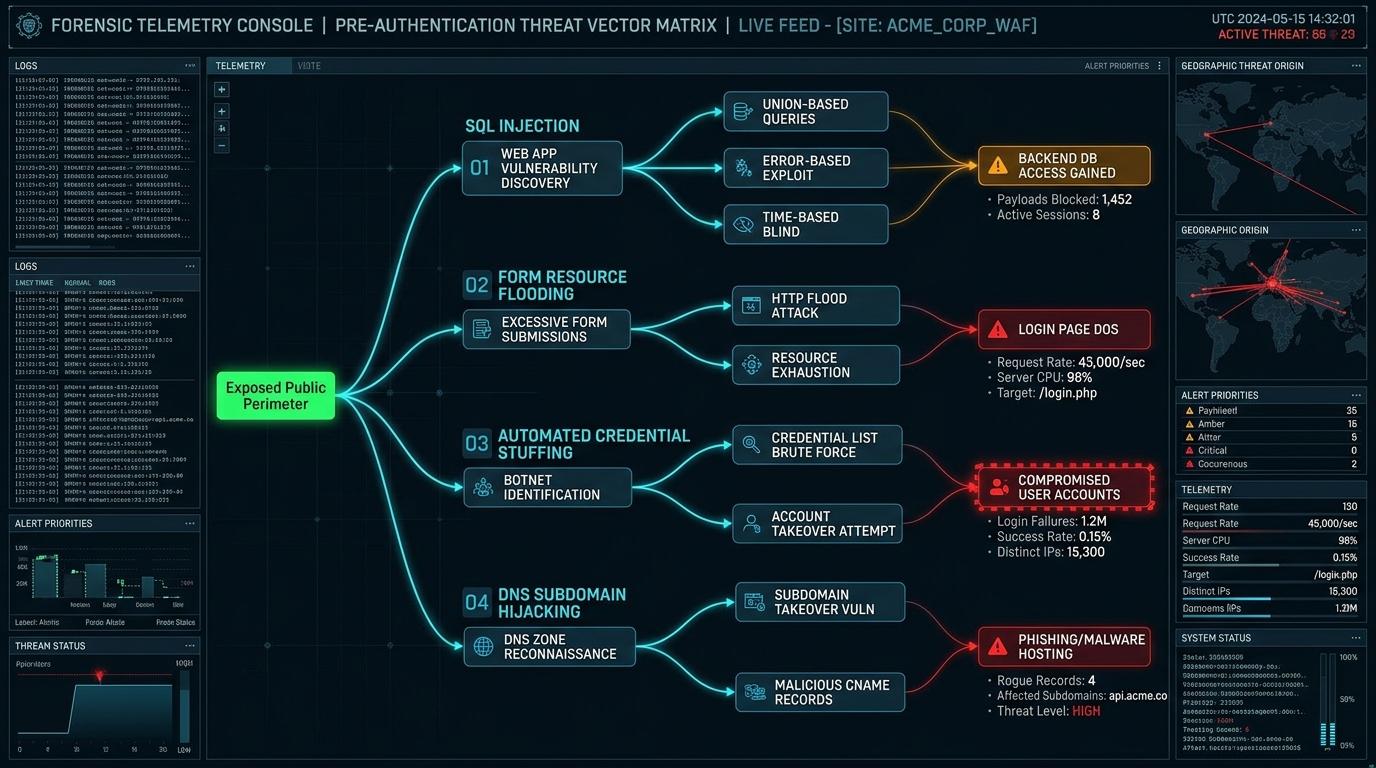
EVIDENTIARY CAPTURE:Forensic telemetry console mapping four pre-authentication exposure pathways: SQL injection, form resource flooding, credential stuffing, and DNS hijacking.
02 · Vector 1: SQL Injection (SQLi) & Data Layer Tampering
Relational databases run on Structured Query Language (SQL). Under standard operations, when a legitimate user inputs a username into an authentication form or searches for a past project, the web server generates a structured command to the database:
SELECT * FROM users WHERE username = 'admin' AND password = 'UserPassword123';
If an application is engineered without strict parameter isolation and input escaping, an attacker can input database commands directly into a standard text field:
admin' OR '1'='1' --
The underlying interpreter executes the altered syntax:
SELECT * FROM users WHERE username = 'admin' OR '1'='1' --' AND password = '...';
Because '1'='1' is mathematically and logically true, the database bypasses the password check entirely. It validates the query, authenticates the attacker as the primary administrative account, or outputs the entire proprietary contents of the database (bid estimations, employee directories, and private messages) directly to the screen.
NETWORK RECONNAISSANCE TELEMETRY
-- Standard Legitimate Execution Query:
SELECT * FROM users WHERE username = 'admin' AND password = 'UserPassword123';

-- Injected Threat Actor Syntax:
SELECT * FROM users WHERE username = 'admin' OR '1'='1' --' AND password = '...';
03 · Vector 2: Form Flooding & Server Resource Exhaustion
Public intake utilities, contact routes, and bid request forms are frequently mismanaged as harmless user interfaces. In reality, dynamic forms are unauthenticated execution triggers tied to your server's internal memory and processor cores.
When a user submits a form, the web server must allocate memory to sanitize fields, run spam filters, establish a connection to write records into the database, and trigger an internal mail delivery service (such as standard PHP mail routines).
Automated threat networks weaponize this pipeline:
1. Thread Concurrency Starvation:
Attack scripts dispatch thousands of automated form submissions per minute through distributed nodes.
2. Database Lockout:
The constant surge of write operations saturates the database connection pool. The database engine locks up, exhausting CPU threads.
3. Total Outage:
The server crashes under the artificial load, returning persistent 504 Gateway Timeout or 500 Internal Server Error screens. Legitimate corporate clients, prospective trade partners, and institutional project teams cannot reach the firm.
04 · Vector 3: Automated Credential Stuffing & Multi-Threaded Scripts
Attacking an exposed administrative gateway manually is obsolete. Threat actors rely on high-velocity multithreaded scripts that run non-stop:
1. Credential Stuffing:
Attackers load automated tools with millions of previously breached username-and-password combinations purchased from illicit credential dumps. The script systematically inputs combinations into the public /wp-admin or login panel at thousands of attempts per minute.
2. Dictionary & Parameter Attacks:
If passwords are strong, scripts test known plugin vulnerability payloads, exposed debug endpoints, and default API routes (such as active XML-RPC listeners) to bypass front-end forms entirely.
3. Zero Human Fatigue:
An automated script does not get tired. If an unhardened gateway sits on the public internet, it will be subjected to thousands of programmatic attempts until a vulnerability matches.

EVIDENTIARY CAPTURE:Real-time terminal monitor capturing high-velocity multi-threaded botnet credential stuffing targeting an unshielded administrative login endpoint.
05 · Vector 4: Domain Hijacking, DNS Tampering & Spoofed Communications
Even before breaking into a web server directly, threat actors routinely target unmanaged domain name system (DNS) infrastructure:
1. Missing Authentication Records:
Neglected corporate domains often lack strict enforcement of SPF, DKIM 2048-bit cryptographic signatures, and enforced DMARC quarantine policies. This structural absence allows an external actor to easily forge emails that appear to originate directly from corporate executives (president@companydomain.com).
2. Subdomain & DNS Hijacking (Dangling CNAMEs):
If an organization previously connected a landing page, external blog, or project portal to an outside service and later deleted the account without removing the DNS record (a dangling CNAME), attackers claim that external endpoint. They serve malicious software or spoofed payment gateways under the company's trusted domain name without touching the primary web server.
3. Electronic Transaction Manipulation:
Attackers use spoofed communications to monitor project milestones and alter Electronic Funds Transfer (EFT) routing instructions right as major project draws or vendor payouts are scheduled to clear.
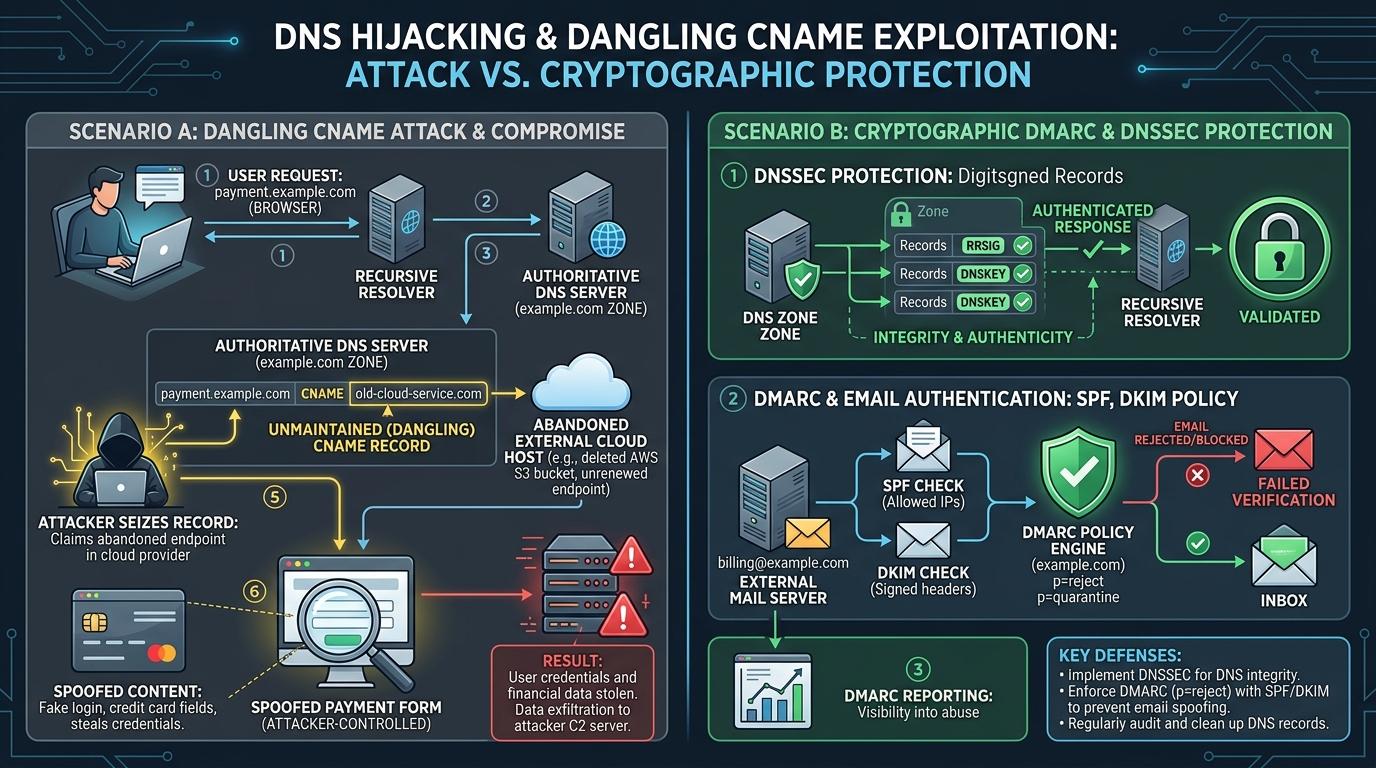
EVIDENTIARY CAPTURE:Architectural attack breakdown comparing dangling CNAME subdomain hijacking against cryptographic DMARC and DNSSEC protection mechanisms.
06 · Active Perimeter Defense & Continuous Infrastructure Oversight
Eliminating these pre-authentication risks cannot be solved with an off-the-shelf security plugin or a one-time configuration update. The speed at which new vulnerability signatures are cataloged means an unmonitored dynamic system remains in a perpetual state of decay.
This is why specialized commercial operations require active, dedicated systems infrastructure support:
1. Active Perimeter Hardening:
Isolating administrative doorways behind zero-trust edge tunnels and cryptographic verification keys, completely cutting off public access.
2. Regional Edge Enclosure:
Dropping malicious offshore automated probes, botnet sweeps, and scrapers before they complete a TCP connection, shielding public intake routes from resource exhaustion.
3. Modern Headless Isolation:
Eliminating relational databases from public traffic entirely by compiling sites into immutable, static edge distributions (Next.js/React).
4. Continuous Infrastructure Oversight:
A dedicated engineering team that manages edge firewall policies, inspects real-time telemetry logs, and enforces cryptographic domain integrity so leadership never has to worry about perimeter liability.
Once an attacker bypasses an unhardened gateway and establishes administrative persistence inside a production environment, the operational damage expands exponentially.