

01 · The Silence Surrounding Commercial Cyber Exploitation
A persistent misconception across mid-market enterprise leadership is that severe cyber incidents always generate public headlines. Executives read about global ransomware paralyzing multinational pipelines or massive database leaks exposing consumer credit bureaus, and conclude: "If our competitors or peers across the regional commercial corridor were being hijacked, we would hear about it."
In commercial operations, the most lucrative and destructive exploits never make the news.
Cybercrime syndicates do not seek publicity; they prioritize liquidity and quiet operational persistence. When a commercial firm or trade operator experiences domain weaponization, shadow hijacking, or transaction interception, the incident is rarely publicized:
1. Strict Non-Disclosure:
Victim enterprises sign mutual non-disclosures with insurers, banks, and legal counsel to protect bonding pre-qualification, commercial credit lines, and customer trust.
2. Reputational Survival:
Announcing that customer deposits or supplier communications were manipulated on your watch destroys commercial standing across competitive trade corridors.
3. Silent Victimization:
In an alarming percentage of intrusions, organizations remain completely unaware that their corporate namespace was ever weaponized on their behalf.
The absence of public noise is not evidence of safety; it is evidence of an exploit ecosystem specifically engineered to stay invisible to victim enterprises and standard law enforcement alike.

EVIDENTIARY CAPTURE:Confidential executive briefing examining non-disclosure agreements, corporate credit impacts, and the hidden prevalence of commercial cyber incidents.
02 · Phase 1: Ephemeral Campaign Cycles & The "Clean Restoration" Trick
Unlike brute-force attackers who break an application to demand a crude public ransom, sophisticated threat actors treat commercial domain hijacking as a transient harvest operation:
1. Ephemeral Infiltration:
Threat actors gain control of unauthenticated DNS records, dangling aliases, or unhardened entry points. They do not permanently deface the site. Instead, they inject custom-coded form hooks, launch high-velocity spam relays, or stage targeted payment redirection mechanisms during peak commercial billing cycles.
2. Objective Fulfillment:
Over a 72-hour to 5-day window, incoming invoices, customer retainers, or supplier banking updates are quietly harvested and diverted to offshore merchant processors or shell accounts.
3. The Clean Restoration:
Once capital is exfiltrated or a phishing blast concludes, the attackers do not leave a smoking gun. They remove the fraudulent pages, purge transient logs, and restore the original forms and DNS parameters to their baseline state.
4. The Dormant Loop:
To an untrained business owner or internal staff reviewing the site weeks later, everything appears normal. Meanwhile, the adversary retains a persistent, dormant backdoor key (webshell), returning months later during another high-volume trade milestone to execute the exact same extraction.
Because the damage is phased and quiet, business owners attribute sudden losses to banking errors, customer miscommunications, or unreturned phone calls—never realizing their unmonitored digital infrastructure served as the weapon.
NETWORK RECONNAISSANCE TELEMETRY
[Adversary Infiltrates / Hijacks Namespace Assets]
       │
       ▼
[Execute Phased Capital Extraction (Invoices / Deposits / Spam Blasts)]
       │
       ▼
[Erase Audit Trails & Revert DNS Records / Form Routes to Original State]
       │
       ▼
[Dormant Cooldown Period (Adversary Retains Persistent Backdoor)]
       │
       ▼
[Return Months Later to Repeat the Harvest Unnoticed]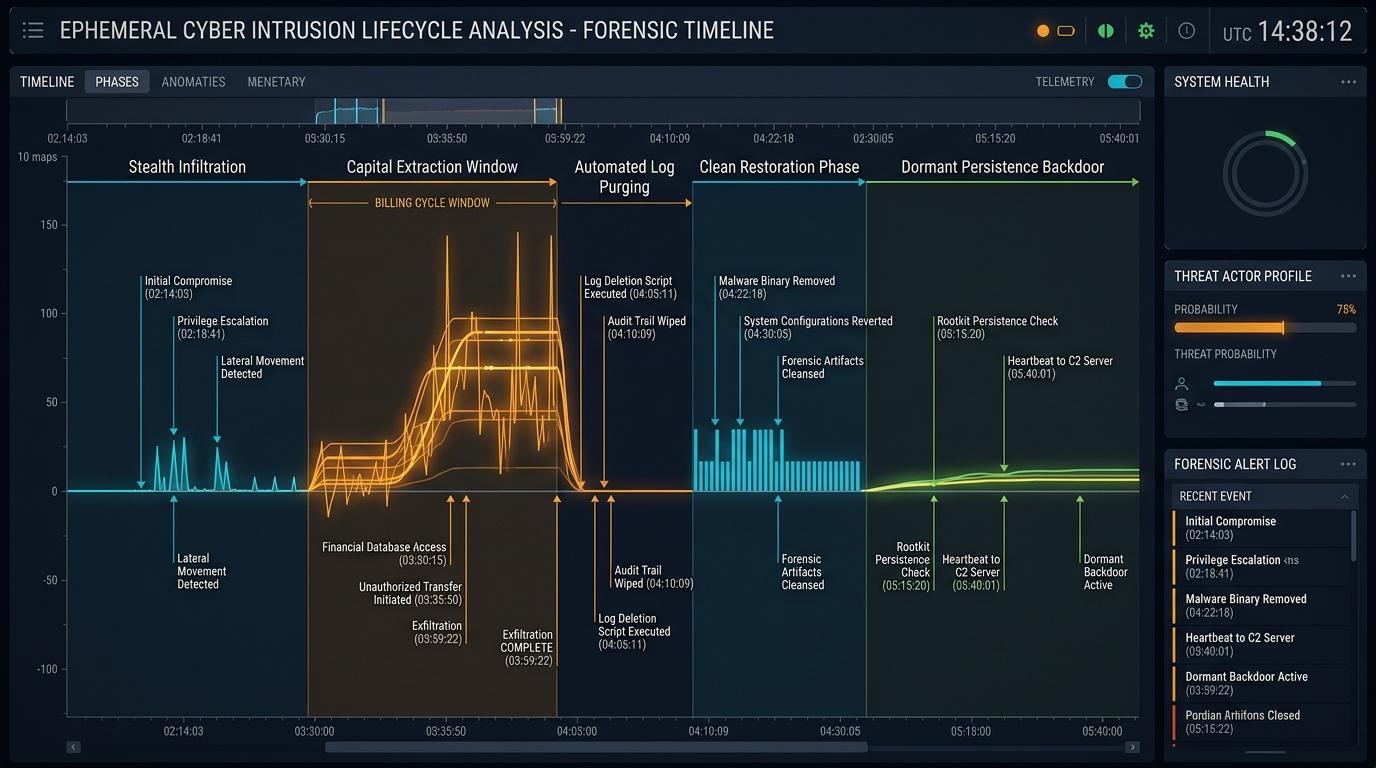
EVIDENTIARY CAPTURE:Forensic lifecycle telemetry mapping a 72-hour ephemeral intrusion cycle from silent infiltration and capital diversion to automated log erasure.
03 · Phase 2: The Fallacy of Historical Safety
The most hazardous executive assumption in corporate infrastructure is the normalcy bias: "We have operated for ten years without an incident; therefore, our systems are inherently safe."
In systems engineering, the absence of an incident to date is merely an artifact of botnet scan timing, not perimeter resilience.
Autonomous botnets and criminal syndicates scan global IP blocks and business registries 24/7/365, methodically matching unmaintained directories, expired DNS aliases, and outdated scripting environments against active vulnerability payloads.
Relying on past luck to defend future capital is the operational equivalent of leaving an unmonitored back door unlocked in an industrial park: the fact that an intruder has not stepped through the frame yet does not mean the building is secure. It simply means a threat actor has not turned the handle yet.
Complacency is the exact behavioral profile offshore actors rely on. They systematically hunt for established, cash-flowing commercial operators whose owners focus entirely on field operations while treating their web perimeter as an abandoned brochure.
NETWORK RECONNAISSANCE TELEMETRY
[THE EXECUTIVE'S ILLUSION]
"10 Years Online Without An Issue" ──► Assumes Perimeter is Secure

[THE ADVERSARY'S REALITY]
"Thousands of Unmonitored IP Scanners" ──► Simply waiting for your asset to match an exploit payload
04 · Phase 3: The Enforcement Vacuum & Jurisdictional Arbitrage
When commercial victims finally discover a payment diversion or domain compromise, their initial instinct is to contact local authorities or corporate banking fraud departments: "Our domain was hijacked and deposits were redirected. We will file a police report and let law enforcement retrieve the capital."
This exposes the structural limitation of regional civil enforcement:
1. The Offshore Jurisdictional Barrier:
Modern threat actors operate within decentralized syndicates stationed across jurisdictions in Southeast Asia, Eastern Europe, and non-extradition territories. Municipal police agencies, provincial authorities, and regional courts hold zero legal authority, investigative reach, or operational subpoena power to freeze assets, seize servers, or penalize perpetrators operating beyond domestic borders.
2. Multi-Hop Routing & VPN Obfuscation:
Attackers never interface with target servers directly. They route automated scripts and manual administrative sessions through multi-hop Virtual Private Networks (VPNs), compromised residential proxy rings, and decentralized bulletproof hosters worldwide.
3. The Civil Law Enforcement Limit:
To a municipal fraud detective, an IP address resolving to an offshore VPN node or a temporary residential address in another continent is an immediate dead end.
By the time a local police report is formally filed, the adversary has already cleared the funds through automated cryptocurrency mixers or offshore merchant shells, purged the attack logs, and vanished.
Relying on external civil authorities for perimeter restitution after a cyber intrusion is a structural dead end. In digital infrastructure, prevention and active perimeter defense are the only actionable remedies that exist.

EVIDENTIARY CAPTURE:Global threat intelligence map visualizing decentralized multi-hop proxy chains routing through non-extradition offshore jurisdictions.
05 · Phase 4: Active Forensic Telemetry vs. Advanced Obfuscation
Standard site builders and generic web platforms provide zero defensive visibility against obfuscated attacks. A basic CMS dashboard or generic hosting panel cannot tell the difference between a legitimate human visitor and an adversary routing through a domestic commercial VPN.
Defeating advanced evasion requires high-fidelity edge telemetry and deterministic behavioral analysis upstream from your web assets:
1. Deep Protocol & TLS Fingerprinting:
Even when an offshore attacker hides behind a North American VPN or residential proxy, their execution runtime leaves forensic markers. Upstream edge telemetry audits the cipher suites, TCP window sizes, and TLS handshakes in real time. If an incoming connection exhibits software signatures mismatched with authentic enterprise browsers, the session is isolated and dropped.
2. Behavioral Cadence Monitoring:
Legitimate trade clients and commercial partners navigate human interfaces with predictable visual rhythms. Threat actors executing reconnaissance or form tampering dispatch high-velocity sequential requests. Dedicated systems engineering flags this cadence instantly, locking out the subnet before an entry route can be cataloged.
3. Complete Air-Gapped Isolation:
By transitioning production assets off dynamic, public-facing database platforms into pre-compiled, static Next.js edge environments, you eliminate the target surface altogether. There is no database listener attached to public routes, no administrative doorway exposed to the web, and zero execution environment for a persistent backdoor to latch onto.
NETWORK RECONNAISSANCE TELEMETRY
[Threat Actor Routes Through Domestic VPN / Proxy Loop]
       │
       ▼
┌────────────────────────────────────────────────────────┐
│ Vector Advisory Group: Upstream Edge Telemetry Layer   │
└────────────────────────────────────────────────────────┘
       │
 ┌─────┴─────────────────────────────────────────────────┐
 ▼                                                       ▼
[Deep Header & TLS Fingerprint Audit]   [Behavioral Request Cadence Analysis]
Detects discrepancies between reported   Identifies automated traversal patterns
browser and underlying packet signatures. characteristic of botnet reconnaissance.
       │
       ▼
[DETERMINISTIC ANOMALY ISOLATION & DROP (<15ms)]
Probes terminated at the edge boundary before touching application code.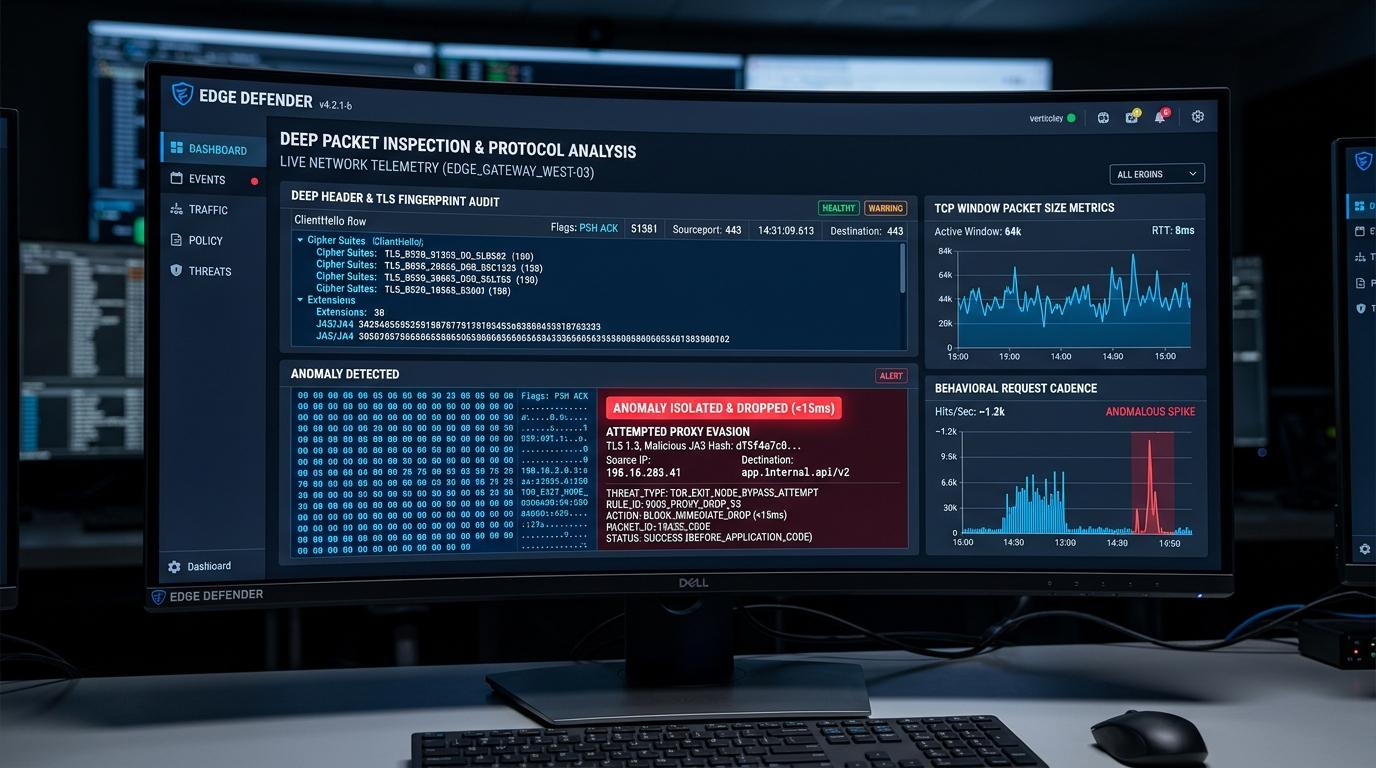
EVIDENTIARY CAPTURE:Upstream edge protocol analysis isolating deep header discrepancies, JA3/JA4 TLS fingerprint anomalies, and dropping evasive proxy probes under 15ms.
06 · The Governance Mandate: Independent Infrastructure Defense
You do not secure a multi-million-dollar commercial enterprise by ignoring infrastructure liabilities or hoping offshore syndicates bypass your trade name.
You defeat them by retaining dedicated technical specialists who understand active attack mechanics, maintain continuous edge governance, and deploy immutable architectures built to withstand automated global reconnaissance.
Vector Advisory Group operates as an external, high-assurance systems practice for commercial operators across Ontario and Quebec. We bridge the gap between commercial operations and technical defense—eliminating exposed administrative surfaces, enforcing strict cryptographic domain authentication, and deploying resilient edge systems designed to safeguard company cash flows and protect corporate standing.
To verify your perimeter health, investigate potential namespace vulnerabilities, or discuss migrating your operational web footprint to zero-attack-surface edge infrastructure, engage our practice directly:
• Executive Inquiries & Perimeter Audits: utsav@vectoradvisorygroup.com
• Encrypted Intake Portal: vectoradvisorygroup.com/contact
• Technical Publications Directory: vectoradvisorygroup.com/advisory
• Practice Headquarters: Montreal, QC · Serving Ontario & Quebec Commercial Corridors

EVIDENTIARY CAPTURE:Sovereign static edge architecture workstation monitoring immutable production deployments, live firewall policies, and zero-trust perimeter governance.