

01 · The Blind Spot: Assets You Never Knew Existed
A dangerous assumption in commercial management is that cybersecurity begins and ends with the company's active website.
Many trade contractors, suppliers, and regional operators operate entirely by word of mouth, vendor referral networks, or private procurement lists. Some decide: "We do not need an official website, so we carry zero digital risk." Others maintain an incorporated legal entity while running operations through direct telephone lines, local job sites, or basic private email accounts.
This creates a high-yield attack vector known as Shadow Brand Hijacking.
Threat actors do not need an organization to possess an active web server to exploit its commercial identity. If an enterprise fails to claim and actively defend its digital perimeter, bad actors will claim it on the company's behalf. The absence of an official digital footprint does not protect a commercial firm; it merely cedes absolute control of its brand reputation, customer trust, and corporate identity to automated offshore syndicates.

EVIDENTIARY CAPTURE:Commercial infrastructure advisory briefing evaluating corporate namespace assets and perimeter exposure across Ontario and Quebec commercial corridors.
02 · Phase 1: Autonomous Registry Scraping & Opportunity Discovery
Offshore spam operations and cyber syndicates do not manually research targets. They deploy automated scrapers programmed to monitor public corporate registries 24 hours a day, 7 days a week, 365 days a year:
1. Public Data Ingestion:
Crawlers ingest state, provincial, and municipal corporate databases (e.g., Ontario Business Registry, Registraire des entreprises du Québec, Canada Federal Corporations database).
2. Data Correlation:
The scripts extract legal corporate names, officer identities, date of incorporation, corporate status, and the registered physical office address.
3. The Domain Availability Audit:
The script checks global domain registrars across dozens of top-level domains (.com, .ca, .org, .net).
4. The Target Flag:
If a registered corporation with active commercial standing possesses no registered domain or an abandoned, expired registration, the corporation is cataloged in an exploitation database.
The offshore syndicate purchases the exact matching domain (or a near-identical variant) for $10 to $12. Because the legitimate business never registered it, the acquisition raises zero legal flags at the registrar level.
NETWORK RECONNAISSANCE TELEMETRY
[Public Business Registries / Corporate Filings]
       │
       ▼
[Automated Offshore Registry Scrapers (24/7)]
       │
       ▼
[Cross-Reference: Domain Lookup on Root Zones (.ca / .com)]
       │
 ┌─────┴─────────────────────────────────────┐
 ▼                                           ▼
[Official Domain Active]          [No Matching Domain Registered]
(Target for Gateway Probes)       (IMMEDIATE HIJACK OPPORTUNITY)
EVIDENTIARY CAPTURE:Production telemetry monitor capturing automated corporate registry scraping cross-referenced against global registrar root zones (.ca, .com).
03 · Phase 2: Synthetic Asset Deployment & The Long Game of Spam
Once an offshore actor controls a domain matching a registered corporation, they execute an automated infrastructure buildout:
1. Synthetic Front-End Scaffolding:
Attackers launch a boilerplate template populated with scraped corporate registry details. They list the corporate address, the principal's legal name, and generic trade imagery. To a homeowner, commercial general contractor, or procurement clerk searching the company name, the synthetic website appears authentic.
2. Rogue Inquiry & Data Interception:
Prospective clients seeking estimates or services submit proposals, residential addresses, blueprints, and contact numbers directly through the synthetic form. The bad actor collects this intelligence, resells it across lead-generation black markets, or uses it to stage targeted theft operations.
3. High-Velocity Spam & Phishing Infrastructure:
The syndicate configures external mail exchange servers on the domain. They initiate mass email campaigns promoting fraudulent wire transfers, deceptive software, or phishing traps. Because the domain matches an active, legally incorporated trade contractor, these emails bypass basic spam heuristics far longer than generic random domains.
4. Reputational Destruction:
The legitimate business principal has no idea this infrastructure exists until angry recipients call the corporate office, local police launch fraud inquiries, or commercial suppliers place active trade accounts on hold due to flagged spam reports.
NETWORK RECONNAISSANCE TELEMETRY
[Offshore Actor Acquires Unregistered Domain]
       │
       ▼
[Synthetic Website Deployed (Scraped Logos / Bogus Team Pages)]
       │
 ┌─────┴─────────────────────────┬───────────────────────────────┐
 ▼                               ▼                               ▼
[Autonomous Form Harvesting]    [High-Velocity Spam Relays]     [Brand Extortion & Impersonation]
Captures customer RFPs,         Fires millions of phishing      Intercepts vendor credit,
deposits, & private phone       blasts using legitimate         redirects supplier inquiries,
numbers across the region.      corporate registry details.     or demands payment to release domain.
EVIDENTIARY CAPTURE:Forensic dual-screen telemetry workstation analyzing synthetic template deployment, form data harvesting, and unauthorized mail relay routing.
04 · Phase 3: The Operational Paradox — Doing Business Without Digital Defense
The natural, defensive executive reaction is often: "Then we should shut down our digital presence entirely, avoid technology, and operate strictly on paper."
This reaction fundamentally misunderstands the problem. You cannot opt out of the internet when public registries publish your business data by law.
Ceasing business operations or refusing to establish an official perimeter does not stop offshore syndicates; it makes their impersonation efforts completely uncontested. When a firm has zero authenticated web presence:
1. Search Engine Monopolization:
Search engines return the hijacker's synthetic website as the primary result for the company name.
2. Absence of Authoritative Verification:
Customers and partners have no official digital authority to compare against the counterfeit portal.
3. Institutional Audit Vulnerability:
Municipalities, lenders, and bonding underwriters auditing corporate standing verify against whatever active domain occupies the company's name.
The problem is not the technology itself. The problem is operating commercial assets without dedicated, professional technical oversight.
Just as a commercial builder would never construct a facility without licensed structural engineers, corporate leadership cannot leave digital infrastructure unmonitored. Defeating sophisticated, automated overseas syndicates requires proactive asset hardening, strict cryptographic domain ownership, and ongoing perimeter governance.
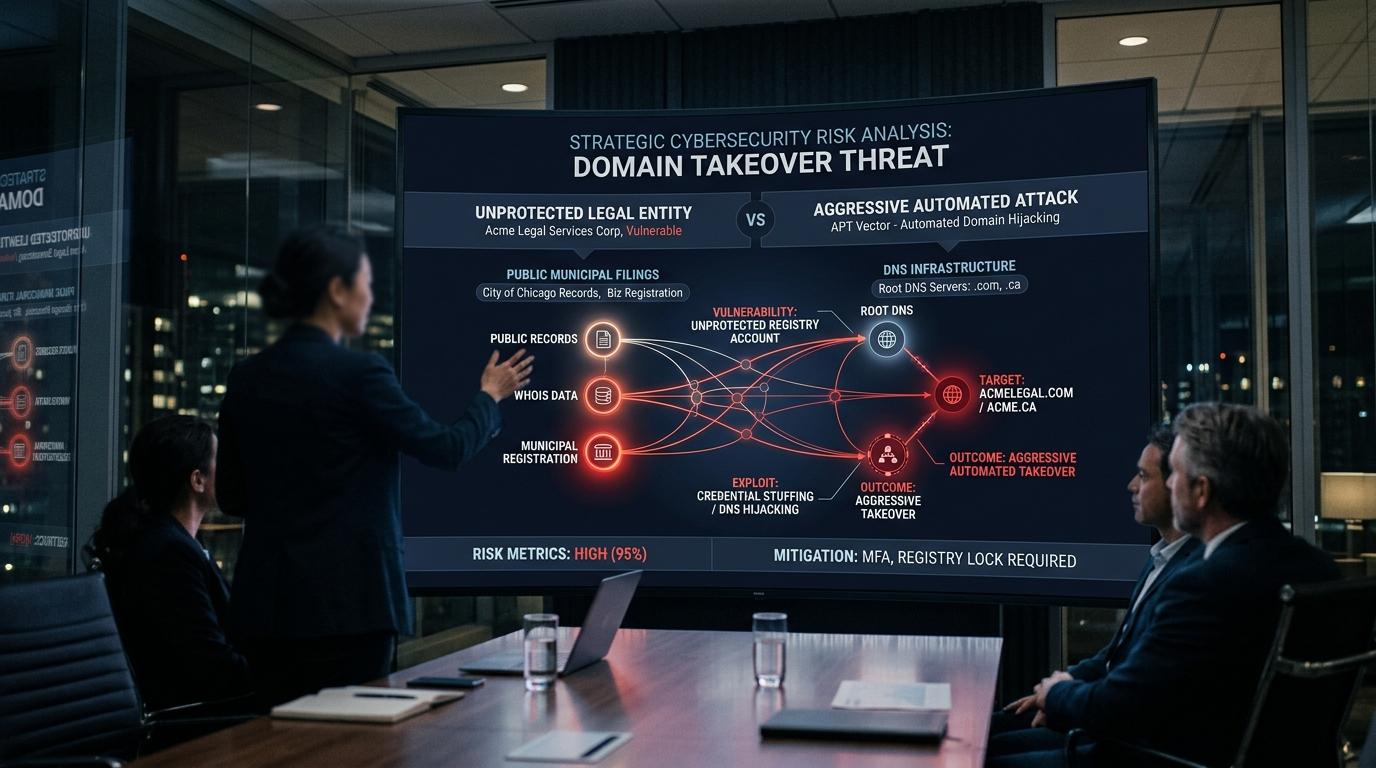
EVIDENTIARY CAPTURE:Executive risk briefing analysis comparing unprotected corporate legal entities against aggressive automated domain takeover syndicates.
05 · The Defensive Mandate: Perimeter Claiming & DNS Hardening
Securing an organization from shadow exploitation requires locking down ownership and establishing an authoritative digital shield:
1. Defensive Asset Acquisition:
Corporate leadership must preemptively secure all primary domain variations (.com, .ca, and key regional extensions) corresponding to their legal and operating names, regardless of whether a full public website is immediately planned.
2. Cryptographic Perimeter Enforcement:
Every owned domain must be locked with strict DNS authentication records:
• SPF (Sender Policy Framework): Declares precisely which mail servers are permitted to send emails for the company.
• DKIM (DomainKeys Identified Mail): Signs authentic correspondence with 2048-bit cryptographic signatures, ensuring forged emails are dropped by recipient gateways.
• DMARC Enforcement: Configured with a p=reject or p=quarantine policy so mail servers worldwide immediately destroy spoofed emails sent by unauthorized third parties.
3. Sovereign Static Infrastructure:
Deploying an authoritative, immutable static edge footprint (such as Next.js/React) ensures that any search for the corporate name resolves directly to a bank-grade, secure platform under internal control. This completely locks out rogue actors from staging counterfeit websites.

EVIDENTIARY CAPTURE:Cryptographic perimeter defense architecture detailing SPF, DKIM 2048-bit signature verification, and DMARC p=reject enforcement protocols.
06 · Engaging Professional Systems Protection
Managing domain defensive perimeters, intercepting unauthorized namespace registrations, and locking down DNS records cannot be handled by ad-hoc marketing templates or casual internal staff.
Vector Advisory Group operates as an external systems and infrastructure practice specializing in commercial trade perimeter security. We audit corporate namespace assets, eliminate exposed entry vectors, deploy authoritative edge architectures, and establish continuous perimeter governance to protect business continuity, reputation, and project margins.
To evaluate your corporate domain health, claim exposed namespace assets, or review our technical standards, submit your matter reference directly through our encrypted intake route:
• Executive Inquiries & Infrastructure Audits: utsav@vectoradvisorygroup.com
• Secure Intake Portal: vectoradvisorygroup.com/contact
• Technical Publications Directory: vectoradvisorygroup.com/advisory
• Practice Headquarters: Montreal, QC · Serving Commercial Corridors across the United States & Canada